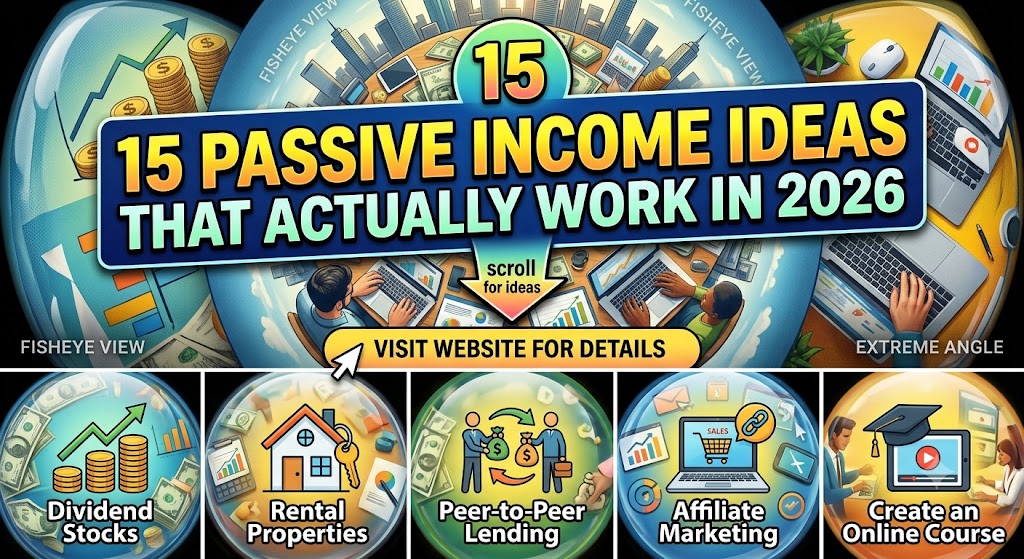
Passive Income in 2026: Building Wealth in the Age of Automation
The financial landscape of 2026 is vastly different from the world we knew just a few years ago. We have officially transitioned from the “Information Age” into the “Automation Age.” In this new era, the traditional 9-to-5 model is no longer the primary vehicle for wealth creation. Instead, the most successful individuals are those who have mastered the art of decoupling their time from their income.
Passive income is no longer a luxury or a “side hustle”—it is a necessity for financial survival and freedom. With AI-driven efficiencies, decentralized finance (DeFi) reaching maturity, and the tokenization of physical assets, the barriers to entry have never been lower, yet the strategies have never been more sophisticated.
This guide serves as your comprehensive blueprint for navigating the passive income streams that are dominating 2026.
1. The New Frontier: AI-Powered Passive Income
By 2026, Artificial Intelligence has moved beyond simple chat interfaces. It now functions as autonomous agents capable of managing entire business ecosystems with minimal human intervention.
Autonomous Content Networks
In 2026, “niche sites” have evolved into autonomous content networks. Instead of writing blog posts manually, savvy entrepreneurs use specialized AI agents that monitor trending topics in real-time, generate high-value multimedia content (video, audio, and text), and optimize it for semantic search engines.
- How it works: You deploy an AI “editor-in-chief” that manages a fleet of specialized writing agents. These agents produce content that solves specific user problems, monetized through high-ticket affiliate programs or programmatic ad networks that pay in real-time.
- The 2026 Edge: The focus has shifted from “quantity” to “authority.” Passive income earners now use AI to synthesize deep-dive whitepapers and interactive tools that provide more value than a standard 800-word article.
Custom GPTs and Specialized AI Marketplaces
The marketplace for specialized AI models is booming. By creating a custom GPT or an AI plugin that solves a niche problem—such as “Architectural Code Compliance Checker” or “AI Nutritionist for Biohackers”—you can earn royalties every time a user interacts with your tool or subscribes to your premium layer.
2. Digital Real Estate: Micro-SaaS and No-Code Ecosystems
Digital real estate used to mean owning a domain name. In 2026, it means owning a piece of the software infrastructure that people use daily.
The Rise of Micro-SaaS
A Micro-SaaS is a software-as-a-service product that solves a very specific problem for a very specific niche. With no-code platforms having reached full maturity, you no longer need to be a developer to build a $5,000/month recurring revenue stream.
- Why it works in 2026: The “Great Fragmentation” of the internet means users want specialized tools, not “all-in-one” behemoths. A tool that specifically helps “Vegan Bakery Owners manage Instagram Orders” is more valuable than a general CRM.
- Maintenance: Once built, these tools require minimal updates, making the revenue almost entirely passive.
- The Ultimate Guide to Passive Income in 2026
- 1. What Is Passive Income and Why It Matters in 2026
- Learn what passive income really means, how it differs from active income, and why building multiple income streams is becoming essential in today’s economy.
- 2. How Passive Income Works
- Understand the basic principles behind earning money with minimal ongoing effort, including the role of automation, digital assets, and smart investments.
- 3. Benefits of Building Passive Income
- Discover how passive income can help you achieve financial freedom, reduce financial stress, diversify your earnings, and create long-term wealth.
- 4. Best Passive Income Ideas for Beginners
- Explore beginner-friendly methods like affiliate marketing, blogging, print-on-demand, YouTube, digital products, and dividend investing.
- 5. Passive Income Ideas with Little or No Investment
- Find low-cost opportunities such as freelancing-to-agency models, online courses, stock photography, and content monetization.
- 6. Online Passive Income Opportunities
- Learn how to earn online through blogging, YouTube automation, dropshipping, niche websites, AI-powered businesses, and digital downloads.
- 7. Investing for Passive Income
- Understand how dividend stocks, ETFs, REITs, bonds, and index funds can generate consistent returns over time.
- 8. Create and Sell Digital Products
- Learn how to build eBooks, templates, printables, Notion templates, Canva designs, online courses, and software that sell repeatedly.
- 9. Affiliate Marketing Strategies That Work
- Discover how to choose profitable niches, promote products effectively, drive traffic, and maximize affiliate commissions.
- 10. Real Estate Passive Income
- Explore rental properties, Airbnb, REITs, and real estate crowdfunding as long-term wealth-building options.
- 11. Common Passive Income Myths
- Separate fact from fiction by understanding that passive income requires planning, consistency, and initial effort before becoming more automated.
- 12. Mistakes to Avoid
- Avoid common pitfalls like chasing quick-rich schemes, choosing poor niches, ignoring SEO, and failing to diversify income sources.
- 13. Tools That Make Passive Income Easier
- Discover essential tools for website building, email marketing, automation, AI content creation, analytics, and payment processing.
- 14. How to Build Multiple Income Streams
- Learn how to combine blogging, YouTube, affiliate marketing, investing, and digital products into a sustainable income portfolio.
- 15. Step-by-Step 90-Day Passive Income Plan
- Follow a practical roadmap that helps you choose a niche, build an audience, launch your first income stream, and scale your earnings over the next three months.
- 16. Frequently Asked Questions
- Get answers to common questions about startup costs, earning potential, taxes, timelines, and the best passive income ideas for beginners.
- 17. Final Thoughts
- Passive income is one of the most effective ways to build long-term financial security. Start with one proven strategy, stay consistent, and reinvest your earnings to create multiple streams of income over time.
3. Financial Assets 3.0: Beyond Traditional Stocks
The world of investing has been democratized through blockchain and high-frequency retail trading algorithms.
Tokenized Real Estate (Fractional Ownership)
The barrier to real estate investing has vanished. In 2026, you don’t need $100,000 for a down payment. Through RWA (Real World Asset) tokenization, you can buy “fractions” of commercial buildings, apartment complexes, or even vacation rentals.
- Passive Benefits: You receive your share of the rent daily in the form of stablecoins. There are no tenants to manage and no toilets to fix; the decentralized autonomous organization (DAO) or the management company handles the logistics.
- Liquidity: Unlike traditional real estate, you can sell your “bricks” (tokens) on secondary markets instantly.
Dividend Growth Investing in the “Green” Sector
With the global transition to renewable energy in full swing, “Green Dividends” have become the new “Aristocrat Stocks.” Investing in companies that own the infrastructure of the new economy—electric grids, lithium recycling plants, and carbon capture facilities—provides a dual benefit: capital appreciation and high-yield quarterly payouts.
Automated Yield Farming and Liquidity Providing
While “DeFi” was once seen as risky, 2026 has brought about regulated, “Institutional-Grade” DeFi protocols. By providing liquidity to decentralized exchanges, you earn a percentage of every trade made on the platform.
- Smart Portfolios: New AI-managed vaults automatically move your capital between different protocols to find the highest yield while minimizing risk (Impermanent Loss protection).
4. The Modern Creator Economy: Scalable Intellectual Property
The creator economy has shifted from “chasing views” to “building assets.”
Faceless YouTube & Social Channels (The 2.0 Version)
Faceless channels are more sophisticated now. Using high-fidelity AI voice clones and generative video (like Sora-level technology), creators can run entire documentary-style channels without ever showing their faces or picking up a camera.
- The Secret: The income comes from the “Backend.” High-performing channels are used as top-of-funnel engines to sell digital products, memberships, or physical merchandise handled by automated 3PL (Third Party Logistics).
Digital Product Ecosystems
The era of the “single PDF ebook” is over. In 2026, passive income from digital products comes from “Knowledge Ecosystems.”
- The Vault Model: Instead of one course, you sell access to a living “Vault” of resources, templates, and AI prompts that you update periodically.
- Notion-Based Businesses: Thousands of entrepreneurs earn 6-figures by selling complex Notion systems that act as the “Operating System” for specific lifestyles (e.g., The Ultimate Creator OS, The High-Performance Athlete Tracker).
Print-on-Demand (POD) with Generative AI
POD is no longer about putting a basic logo on a t-shirt. It’s about “Hyper-Personalization.”
- 2026 Trend: AI tools now allow customers to customize your designs in real-time before they buy. You provide the “style” and “brand,” the AI handles the customization, and the POD provider handles the fulfillment. This is “Artist as Curator” passive income.
5. Sharing Economy 2.0: Monetizing Physical Assets
In 2026, if you own it, it should be earning for you.
Battery Energy Arbitrage
If you have a home solar setup and a smart battery (like a Tesla Powerwall 4), you can participate in energy arbitrage. Your system automatically buys energy from the grid when it’s cheap (or stores it from the sun) and sells it back to the grid during peak hours when prices skyrocket.
- Passivity Level: 10/10. Once installed, the software manages the trades for you. It’s literally “earning while you sleep.”
Autonomous Vehicle Fleets
While fully autonomous “Level 5” driving is still rolling out in certain regions, the “Peer-to-Peer” rental market for autonomous-capable vehicles is thriving. Services allow you to list your car, and it can theoretically (in mapped zones) pick up and drop off passengers or deliveries while you are at work.
Automated Storage & Space Rental
The “clutter” of the 2020s has led to a massive demand for storage in 2026. However, people no longer want giant warehouses on the edge of town; they want “Micro-Storage.”
- The Play: Converting unused garage space or basement units into smart-lock accessible storage lockers. Use an app-based management system that handles the keys, security, and payments automatically.
6. The “Invisible” Passive Income: Data and Bandwidth
As the world becomes more data-hungry, your digital “exhaust” has become valuable.
Selling Excess Bandwidth
With the rise of decentralized web (Web3) and AI training, companies need massive amounts of distributed bandwidth. You can install a small plug-and-play device or a software background-task that “rents” out your unused internet bandwidth to companies for web scraping or content delivery.
Data Royalties
New platforms now allow individuals to “own” their data. By opting into anonymous data-sharing pools, you can earn micro-payments every time your consumer data is used to train a retail AI model or inform a market research study. It’s not much per transaction, but as a “set-and-forget” stream, it adds up.
7. The 3-Step Framework to Starting Your Passive Income Journey in 2026
To build a sustainable passive income portfolio, you cannot simply “try everything.” You must follow a structured approach.
Phase 1: The “Active-to-Passive” Bridge
Most passive income requires either Money or Time upfront. If you don’t have capital, you must use “Sweat Equity” to build a digital asset.
- Action: Choose one platform (e.g., Micro-SaaS or YouTube Automation) and dedicate 10 hours a week to building the foundation. Do not expect a return for the first 6 months.
Phase 2: The Optimization Loop
Once your asset starts generating at least $100 a month, your goal is to “Remove Yourself.”
- Action: Use AI tools or inexpensive VAs (Virtual Assistants) to handle the recurring tasks. If you’re running a content site, automate the social media distribution and the basic SEO updates.
Phase 3: The Diversification Cascade
Never rely on a single stream. Platforms change, algorithms shift, and markets evolve.
- Action: Take 50% of the profits from your first stream and “cascade” them into a lower-risk, more permanent asset, such as tokenized real estate or dividend-paying ETFs.
8. Common Pitfalls to Avoid in 2026
The landscape of 2026 is filled with “shiny object” syndrome. To succeed, avoid these traps:
- The “Fully Passive” Myth: No income stream is 100% passive forever. Even a “set-and-forget” AI agent needs occasional “fine-tuning” to stay relevant. Plan for “Maintenance Days” once a month.
- Chasing High-Yield Scams: In the world of DeFi and Crypto, if something offers a 100% annual yield, it’s likely a Ponzi scheme or highly inflationary. Stick to “Real Yield”—income generated from actual economic activity (fees, rents, sales).
- Ignoring Personal Brand: Even in an AI world, people buy from people. Even if your business is faceless, your “Brand Identity” must be consistent and trustworthy.
- Neglecting Security: In 2026, cyber-threats are AI-powered. If your passive income is digital, your security must be top-tier. Use hardware wallets for financial assets and multi-factor authentication (MFA) for all platforms.
9. Conclusion: The Psychology of the 2026 Wealth Builder
The most important asset you possess in 2026 is not your bank account or your AI agents—it is your mindset.
The “Old World” mindset focused on job security. The “New World” mindset focuses on asset security. To thrive, you must stop thinking about “how much I can earn per hour” and start thinking about “how much I can build that earns without me.”
The opportunities listed in this guide are not theoretical; they are being utilized by the “New Rich” to buy back their time. Whether it’s through the precision of an AI-driven Micro-SaaS, the stability of tokenized real estate, or the innovation of energy arbitrage, your path to financial freedom in 2026 is limited only by your willingness to learn and deploy these systems.
Start small, build one automated stream at a time, and by 2027, you may find that the 40-hour work week is nothing more than a distant memory. The future of wealth is automated. Are you ready to build it?