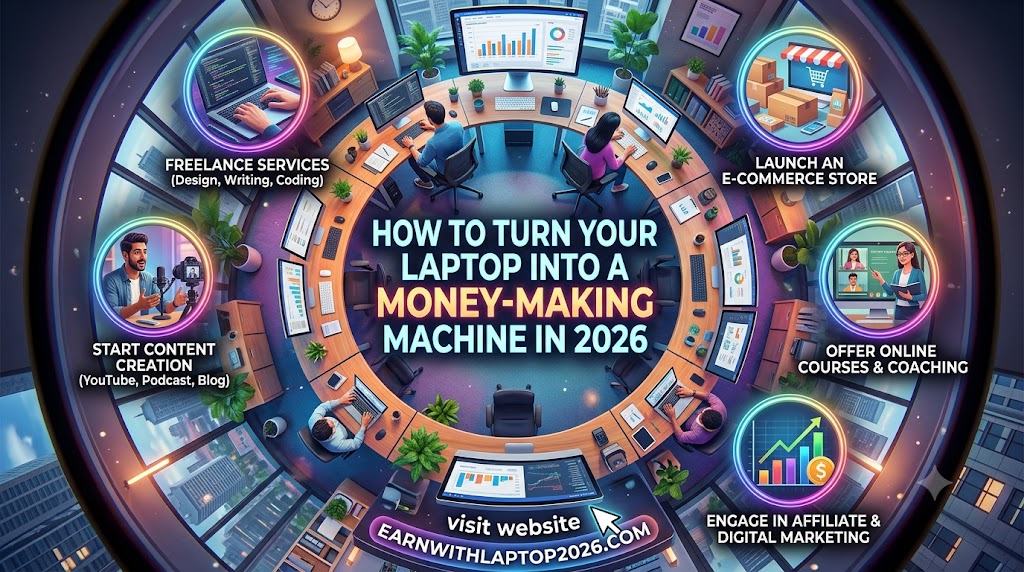
From Screen Time to Paycheck: The Ultimate Guide to Turning Your Laptop Into a Seven-Figure Income Machine
To turn your laptop into an income machine, you must stop viewing it as a device for consumption—scrolling through TikTok or watching Netflix—and start viewing it as a terminal for production. This transformation requires a shift in mindset, a specific set of tools, and a relentless commitment to building systems that work while you sleep.
In this comprehensive guide, we will break down the exact frameworks, industries, and strategies you can use to build a digital empire from your keyboard.
The Core Philosophy: Moving from Labor to Leverage
Before we dive into specific niches, you must understand the concept of leverage. Wealth is not built by trading time for money; wealth is built by using leverage to decouple your income from your hours worked.
There are four types of leverage:
- Labor: Having people work for you (the oldest form).
- Capital: Having money work for you.
- Code: Software and apps that work 24/7.
- Media: Content, books, and videos that reach millions while you sleep.
Your laptop allows you to tap into Code and Media with almost zero overhead. This is why a solo creator can generate more profit than a mid-sized manufacturing company.
1. High-Ticket Freelancing: The Cash Flow Catalyst
The fastest way to start making money on your laptop is to sell a skill. However, the mistake most people make is competing on price in a “race to the bottom” on platforms like Fiverr. To turn your laptop into a machine, you must transition to High-Ticket Freelancing.
The Psychology of High-Ticket Services
A high-ticket service is something you can charge $2,000 to $10,000+ per client for. These are services that solve a “burning pain” for a business or directly help them make more money.
- Direct-Response Copywriting: Writing sales pages, email sequences, and ads. If your words help a company sell $100,000 worth of product, charging $5,000 is a bargain.
- High-End Web Development: Moving beyond basic WordPress sites to complex Webflow builds or custom SaaS (Software as a Service) platforms.
- Media Buying (Ads): Managing Google or Meta ads for e-commerce brands. You are essentially a “money manager” for their marketing budget.
- SEO Strategy: Not just writing blogs, but architecting a technical SEO strategy that ranks a company for high-intent keywords.
How to Scale This
Once you have 3–5 clients, you stop being a freelancer and start being an agency. You hire a junior contractor to do the fulfillment while you focus on sales and strategy. Now, your laptop is no longer a tool for “doing the work”—it’s a tool for “managing the system.”
2. The Creator Economy: Building an “Owned” Audience
If freelancing is about selling your skills, content creation is about selling your attention. The most valuable asset in the 21st century is a loyal audience.
The Newsletter Goldmine
Newsletters are currently the highest-converting form of digital media. Platforms like Substack or Beehiiv allow you to own your audience directly, unlike social media where an algorithm can hide your content.
- The Model: Provide immense value for free 2-3 times a week. Once you have 5,000+ subscribers, you can monetize through sponsorships, premium subscriptions, or selling your own products.
YouTube: The Evergreen Search Engine
YouTube is the second-largest search engine in the world. Unlike Instagram posts that “die” after 24 hours, a YouTube video can generate views (and ad revenue) for years.
- Faceless Channels: You don’t even need to show your face. Using stock footage, AI voiceovers, and tight scripts, you can build “Cash Cow” channels in niches like finance, technology, or travel.
Podcasting and Guesting
Podcasts build a deep level of trust. Listeners spend 30 to 60 minutes with you in their ears. This intimacy translates into high conversion rates for whatever you are selling.
3. E-commerce 2.0: Moving Beyond Basic Dropshipping
Dropshipping has a bad reputation because people tried to sell junk with 30-day shipping times. E-commerce 2.0 is about Brand Building and Niche Specialization.
High-Ticket Dropshipping
Instead of selling $20 phone cases, sell $2,000 infrared saunas or $3,000 electric bikes.
- Why? You only need 10 sales a month to make a significant profit. You deal with fewer customers, higher margins, and you can afford to provide actual customer service.
Print on Demand (POD)
This is the ultimate low-risk entry. You design a product (t-shirts, mugs, posters), and a third party prints and ships it only when a customer buys it.
- The Secret: Focus on “Micro-Niches.” Don’t make a shirt for “Dog Lovers.” Make a shirt for “Left-handed Corgi Owners who love 80s Synthwave.”
Amazon FBA (Fulfilled by Amazon)
You find a product manufacturer in China (via Alibaba), put your own brand on it, and ship it to Amazon’s warehouses. Amazon handles the shipping, returns, and customer service. Your laptop is used to manage inventory levels and optimize your listing’s SEO.
4. The AI Revolution: The New Frontier of Digital Wealth
Artificial Intelligence has lowered the barrier to entry for almost every digital business. If you aren’t using AI on your laptop, you are competing with one hand tied behind your back.
AI Prompt Engineering for Businesses
Companies are desperate to integrate AI but don’t know how. You can charge as a consultant to:
- Build custom GPTs for their internal data.
- Automate their customer service using AI chatbots.
- Streamline their content creation pipeline using tools like Midjourney and Claude.
AI-Assisted Content Agencies
You can now produce 10x the amount of content in 1/10th of the time. An AI-assisted agency can offer social media management, blog writing, and video editing at a fraction of the cost of traditional agencies while maintaining high margins.
5. Digital Products: Scaling to Infinity
The “Holy Grail” of the laptop income machine is the digital product. Why? Because you create it once and sell it an infinite number of times with zero marginal cost of reproduction.
Online Courses and Masterminds
If you have a skill (even a niche one like “How to grow organic tomatoes” or “How to pass the LSAT”), there is an audience willing to pay for your knowledge.
- Tier 1: A $50 E-book.
- Tier 2: A $500 Video Course.
- Tier 3: A $5,000 high-touch Mastermind/Coaching program.
SaaS (Software as a Service)
You don’t need to be a coder to start a software company anymore. You can use No-Code tools like Bubble or Glide to build functional apps. Solve a small, specific problem for a specific group of people (e.g., a CRM for local plumbers) and charge a monthly subscription fee.
6. The “Tech Stack” of a Digital Nomad
To turn your laptop into a machine, you need the right “parts.” These are the essential tools that every digital entrepreneur should have in their arsenal:
- Communication: Slack, Zoom, and Loom (for video updates).
- Project Management: Notion, Trello, or Monday.com.
- Finances: Stripe (for payments), Wise (for international transfers), and Quickbooks (for taxes).
- Marketing: Canva (design), Mailchimp/Klaviyo (email), and Hypefury (social media scheduling).
- Security: A high-quality VPN and a password manager like LastPass or 1Password.
7. The 4-Step Blueprint to Getting Started
If you are starting from zero, don’t try to do everything at once. Follow this sequence:
Step 1: The Skill Phase (Months 1–3)
Pick one high-value skill. Spend 2 hours a day learning it and 2 hours a day practicing it. Document your journey on LinkedIn or Twitter to build “Build in Public” credibility.
Step 2: The Freelance Phase (Months 3–9)
Get your first 3 clients. Work for a lower rate if necessary just to get the testimonials. Your goal here is “Proof of Concept.” Prove that your laptop can generate $1,000.
Step 3: The Productization Phase (Months 9–18)
Take the service you were doing manually and turn it into a product. Create a course or a template pack based on your results. Start a newsletter to capture the traffic you are generating.
Step 4: The Automation Phase (Year 2+)
Hire a Virtual Assistant (VA) from the Philippines or Eastern Europe to handle the day-to-day operations. Use Zapier to connect your apps so that leads are automatically followed up with. At this stage, you are the CEO, not the worker.
8. Overcoming the “Shiny Object” Trap
The biggest reason people fail to turn their laptop into an income machine is not a lack of opportunity, but an excess of it. They try dropshipping for two weeks, get bored, try YouTube, quit after three videos, and then move on to crypto.
Success in the digital world requires “Monomaniacal Focus.”
Pick one niche and one platform. Stay there until you have made your first $10,000. The grass isn’t greener on the other side; the grass is greener where you water it.
9. Managing Your Mind and Body
When your laptop is your office, the boundaries between work and life blur. To sustain a high-income machine, you must maintain the “hardware”—which is you.
- The Deep Work Rule: Block out 4 hours every morning where your phone is in another room and your laptop is in “Do Not Disturb” mode. Use this for your most important task.
- Digital Detox: Every Sunday, put the laptop away. Your brain needs time to recalibrate and find creative solutions that don’t come from staring at a screen.
- Ergonomics: If you’re going to be on a laptop for 8 hours, get a laptop stand, an external keyboard, and a decent chair. Your future back will thank you.
10. The Reality of the “Machine”
Is it easy? No. Is it fast? Usually not. But the ceiling is non-existent. In a traditional job, you might get a 3% raise every year. In the digital economy, you can go from $5k a month to $50k a month in a single year if you hit the right “vein” of demand.
The laptop income machine is built on the foundation of Value Creation. If you focus on solving problems for people and use the internet to scale those solutions, the income becomes an inevitable byproduct.
Final Thoughts
Your laptop is either a distraction device or a wealth-generation tool. The difference lies in which tabs you have open and what you do with your hands on the keyboard. Stop being a consumer of the internet and start being its architect. The world is ready to pay for your expertise, your creativity, and your systems. All you have to do is open the lid and start.
Frequently Asked Questions
Can I really start with zero money?
Yes. High-ticket freelancing and content creation require zero capital, only time and effort. You can use free tools like Google Docs, Canva (free version), and social media to land your first clients.
How long does it take to see results?
Typically, it takes 3 to 6 months of consistent effort to see your first dollar. It takes 12 to 24 months to build a “machine” that generates significant passive or semi-passive income.
Do I need a fancy MacBook?
No. Any laptop that can run a web browser and handle basic multitasking is enough to start. As you scale, you can upgrade your hardware, but don’t let a “bad laptop” be an excuse for not starting today.
What is the most profitable niche right now?
Anything related to AI integration, B2B sales systems, or high-level health and wellness coaching currently commands the highest margins.
How do I stay motivated when working alone?
Join “Digital Masterminds” or online communities of like-minded entrepreneurs. Surrounding yourself with people who are also building “machines” will normalize the process and keep you accountable.