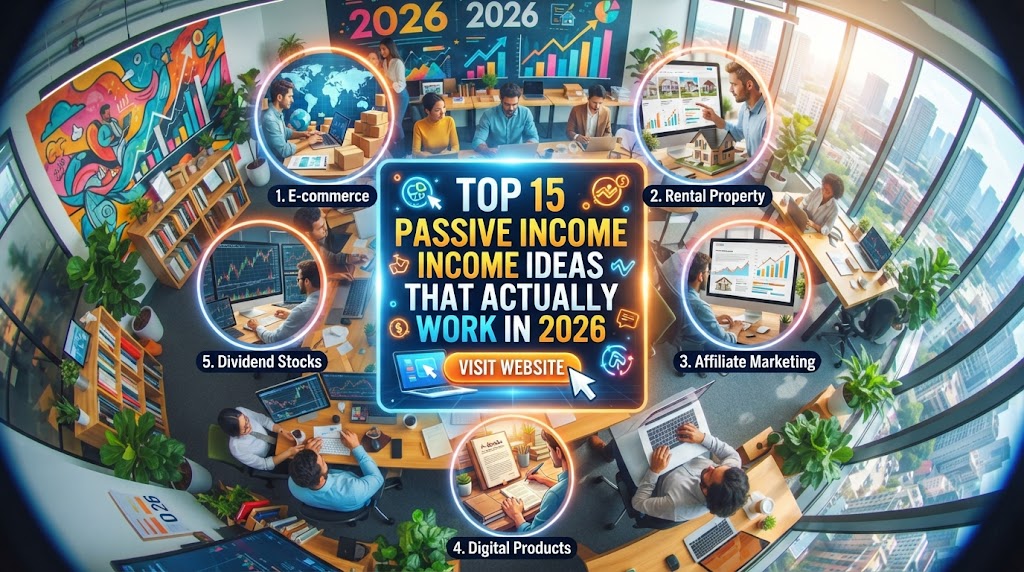
Top 15 Passive Income Ideas That Actually Work in 2026: The Ultimate Guide to Financial Freedom
The landscape of wealth generation has shifted. In 2026, the traditional “9-to-5 until you’re 65” model is no longer the gold standard. We are living in the era of the Leveraged Economy. With the maturation of Artificial Intelligence, the democratization of global finance through blockchain, and the explosion of the creator economy, the barriers to entry for building passive income streams have never been lower—provided you know where to look.
Passive income is often misunderstood. It is not “money for nothing.” It is a system where you front-load the effort, time, or capital to create an asset that continues to generate cash flow with minimal ongoing maintenance. In 2026, the key to success lies in automation and niche positioning.
Here are the top 15 passive income ideas that are actually working in 2026.
1. AI-Powered Micro-SaaS (Software as a Service)
By 2026, the “No-Code” revolution has merged with generative AI, allowing non-technical founders to build highly specific software solutions. A Micro-SaaS is a software tool that solves a very specific problem for a niche audience (e.g., an AI tool that automatically formats legal documents for freelance designers).
- The 2026 Twist: You no longer need a team of developers. Using AI coding assistants, you can build, deploy, and maintain a subscription-based app in weeks.
- How it Works: Identify a repetitive task in a specific industry. Build a tool to automate it. Charge a monthly subscription fee ($10–$50/month).
- Passive Nature: Once the logic is built, the software runs on the cloud. Customer support can be handled by an AI agent trained on your documentation.
2. Real Estate Tokenization and Fractional Ownership
The days of needing $100,000 for a down payment are over. In 2026, blockchain-based real estate platforms allow you to buy “tokens” representing shares of commercial or residential properties.
- Why it Works Now: Regulatory clarity in 2025 paved the way for institutional-grade real estate to be digitized. You can now earn rental dividends from a skyscraper in Dubai or a warehouse in Texas with as little as $500.
- The Benefit: You get the benefits of real estate (appreciation and rent) without the headaches of being a landlord.
- Expected Returns: Typically 6%–12% annually, plus property appreciation.
3. Automated Faceless YouTube Channels (AI-Driven)
Video content is still king, but you no longer need to be on camera. In 2026, creators are using “Agentic AI” workflows to script, voice-over, edit, and publish high-quality video content to YouTube and TikTok.
- The Strategy: Focus on high-CPM (Cost Per Mille) niches like finance, technology, or health. Use AI to analyze trending topics and generate visual sequences.
- Monetization: AdSense revenue, sponsorships, and affiliate links embedded in the description.
- Maintenance: Once the workflow is set up, your primary job is to review the AI-generated drafts for 15 minutes a day.
4. High-Yield Energy Storage and Arbitrage
As the world shifts to renewable energy, the grid has become volatile. In 2026, residential and commercial battery storage systems have become a major passive income play.
- The Method: Invest in smart battery systems (like Tesla Powerwalls or industrial equivalents) that buy electricity from the grid when prices are low (middle of the night) and sell it back to the grid when prices peak (hot afternoons).
- Passive Potential: AI software handles the trading automatically. You simply own the hardware and collect the “spread” or profit margin.
- Scalability: You can participate in “Virtual Power Plants” (VPPs) where thousands of owners pool their battery capacity to support the national grid.
5. Niche Paid Newsletters and Digital Communities
The “death of social media algorithms” has led to a massive migration toward curated, private spaces. People in 2026 are willing to pay for high-quality, filtered information delivered to their inbox.
- The Hook: Instead of a general news site, build a newsletter for “Vertical Farmers in the Midwest” or “AI Prompt Engineers for the Medical Field.”
- Revenue Model: Use platforms like Substack or Beehiiv to charge $5–$20/month for premium insights.
- Passive Growth: Once you have a backlog of evergreen content, you can automate “Welcome Sequences” and “Best of” digests that keep subscribers paying for months or years.
6. Dividend Kings and Aristocrats (The Modern Portfolio)
While tech evolves, the power of compounding dividends remains a cornerstone of wealth. Dividend Kings are companies that have increased their dividend payments for 50+ consecutive years.
- 2026 Strategy: With interest rates stabilizing after the mid-2020s volatility, dividend-paying stocks offer a hedge against inflation.
- The Yield: Target a diversified portfolio yielding 3%–5% with an annual growth rate of 7%–10%.
- Automation: Use “DRIP” (Dividend Reinvestment Plans) to automatically buy more shares with your payouts, accelerating the snowball effect.
7. Digital Product Ecosystems (Print-on-Demand 2.0)
Print-on-Demand (POD) has evolved. In 2026, it’s not just about t-shirts; it’s about 3D-printed home decor, custom tech accessories, and AI-generated art prints.
- The Edge: Use AI design tools (like Midjourney 7 or DALL-E 5) to create high-end aesthetic designs that would have previously required a professional artist.
- Integration: Connect your store (Shopify/Etsy) to automated fulfillment centers. When a customer buys, the product is printed and shipped without you ever touching it.
- Profit Margin: 20%–40% per sale.
8. Peer-to-Peer (P2P) Lending in Emerging Markets
Traditional P2P lending in developed markets is saturated. However, in 2026, platforms connecting Western capital to small businesses in emerging economies (Africa, Southeast Asia, Latin America) have matured.
- The Mechanism: You lend small amounts of capital to entrepreneurs through decentralized finance (DeFi) platforms that use “Social Proof” and “On-Chain Identity” to mitigate risk.
- The Returns: These loans often fetch 10%–15% interest rates because local bank credit in those regions is prohibitively expensive.
- Risk Management: Diversify your capital across hundreds of small loans to ensure one default doesn’t hurt your principal.
9. Vending Machines and Automated Retail
Physical assets are making a comeback. In 2026, vending machines have gone “smart.” We are seeing “Micro-Markets” in office buildings and “Specialty Vending” (electronics, high-end skincare, healthy meal prep).
- The Passive Factor: Modern machines notify you via an app when stock is low. You can hire a third-party logistics company to restock them, making the business almost entirely hands-off.
- High-Traffic Locations: Gyms, hospitals, and transit hubs remain the gold mines.
- ROI: A well-placed machine can pay for itself in 12–18 months.
10. Licensing AI Training Data and Intellectual Property
AI companies are starving for “Clean, Human-Generated Data.” If you own a large blog, a library of photos, or a unique dataset, you can license it to AI labs for model training.
- The Trend: In 2026, new laws protect creators’ rights to their data. You can “rent” your intellectual property to LLM (Large Language Model) developers.
- Passive Income: You receive a one-time licensing fee or an ongoing royalty every time your data is used to fine-tune a model.
- How to Start: Register your content on data-rights marketplaces that act as brokers between creators and tech giants.
11. Automated Affiliate Marketing via “AI Concierges”
The old way of affiliate marketing (blogging and hoping for clicks) is fading. The new way involves “AI Concierges”—chatbots or voice agents that help users find the best products.
- The Setup: Build a specialized AI agent (e.g., “The Ultimate Hiking Guide AI”). When users ask for gear recommendations, the AI provides personalized suggestions with your affiliate links.
- The Platform: Deploy these agents on WhatsApp, Telegram, or as a Chrome extension.
- The Win: The AI handles the “selling” conversation 24/7, while you earn commissions on every purchase made through its recommendation.
12. Carbon Credit Investing for Individuals
By 2026, the voluntary carbon market has become accessible to the average investor. Governments and corporations are under immense pressure to be “Net Zero,” driving up the price of carbon offsets.
- The Asset: You can invest in “Carbon Forestry” projects or “Carbon Capture” startups. As these projects successfully remove CO2 from the atmosphere, they generate credits.
- The Payout: You sell these credits to corporations like Amazon or Delta Airlines who need them to offset their emissions.
- Market Growth: Analysts predict the carbon market to grow by 50x over the next decade.
13. High-Yield Savings Accounts (HYSA) and Money Market Funds
In a post-inflationary 2026, interest rates have settled into a “New Normal” that is significantly higher than the zero-interest era of the 2010s.
- The Play: Keep your “dry powder” (emergency cash) in HYSAs or digital-first banks that offer 4%–5% APY.
- Safety: This is the lowest-risk passive income stream available. It’s the perfect place to park your profits from higher-risk ventures.
- Compound Interest: Monthly payouts can be set to automatically transfer into your brokerage account.
14. Renting Out Niche High-Value Assets
The “Sharing Economy” has moved beyond cars and spare rooms. In 2026, people are making significant passive income renting out specialized equipment.
- Examples: High-end cinema cameras, portable power stations for campers, specialized tools, or even designer handbags.
- Platforms: Use peer-to-peer rental apps (like Fat Llama or Turo) that provide insurance and handle the payment processing.
- The Passive Shift: Use a “Lockbox” system for pickups and drop-offs so you never have to meet the person renting your gear.
15. Selling Digital Templates and “Operating Systems”
As the world becomes more complex, people are looking for “blueprints” for their lives and businesses. If you are good at organizing, you can sell digital “Operating Systems” (OS).
- The Medium: Notion templates, Airtable bases, or specialized CRM setups.
- The Market: Small business owners who need to track their AI workflows, or students who need a “Second Brain” to manage their studies.
- Scaling: Once the template is created, it costs $0 to replicate. Each sale is 95% profit (after platform fees).
The 3 Pillars of Passive Income Success in 2026
To make any of these ideas work, you must understand the three fundamental pillars of wealth generation in the current era.
Pillar 1: Leveraging “Permissionless” Media and Code
In 1990, to reach a million people, you needed a TV station. In 2026, you just need an internet connection. Media (videos, newsletters, podcasts) and Code (apps, scripts, AI agents) are “permissionless.” They work for you while you sleep, and they don’t ask for a salary. This is the ultimate leverage.
Pillar 2: The Shift from Quantity to Quality
Because AI can generate “average” content in seconds, the market value of “average” has dropped to zero. To build a passive income stream that lasts, you must offer extreme utility or unique perspective. Whether it’s a software tool or a newsletter, it must solve a problem better than a generic AI could.
Pillar 3: Reinvestment and Compounding
Most people fail at passive income because they spend their first $100 profit. In 2026, the winners are those who take their profits from one stream (e.g., a vending machine) and use it to fund the next (e.g., tokenized real estate). This “stacking” of income streams is the fastest path to true financial independence.
How to Get Started: Your 90-Day Roadmap
If you are starting from zero, don’t try to launch all 15 ideas at once. Follow this sequence:
Days 1–30: The Foundation
- Audit your skills and capital: Do you have more time or more money? If time, start with AI Content or Digital Templates. If money, start with Real Estate Tokenization or HYSAs.
- Pick ONE niche: Don’t just “make a YouTube channel.” Make a channel specifically for “Sustainable Architecture for Gen Z.”
Days 31–60: The Build
- Create your “Minimum Viable Asset”: Build the first version of your tool, write your first five newsletters, or buy your first property token.
- Set up the automation: Integrate your payment processors (Stripe/PayPal) and your delivery systems.
Days 61–90: The Optimization
- Gather data: Look at what’s working. Are people clicking your affiliate links? Is your SaaS getting signups?
- The “Double Down”: Reinvest your first few dollars of profit back into the business—buy better AI tools, run small ads, or increase your investment stake.
Common Pitfalls to Avoid in 2026
- The “Set it and Forget it” Myth: No income stream is 100% passive forever. Markets change. AI models get updated. Plan to spend at least 2–4 hours a month “checking the gauges” of your systems.
- Chasing “Get Rich Quick” Schemes: If an opportunity promises 50% monthly returns with no risk, it’s a scam or a Ponzi scheme. Stick to assets that provide real value to real people.
- Ignoring Tax Implications: Passive income is still taxable. In 2026, tax authorities have sophisticated AI to track digital transactions. Consult with a professional to set up a proper legal structure (like an LLC) to protect your assets.
The Final Verdict
The year 2026 is a golden age for those who understand the power of automated systems. The wealth gap is widening, not just between the rich and the poor, but between the system-owners and the system-workers.
By choosing one of these 15 ideas and applying a long-term mindset, you aren’t just making “extra money.” You are building a machine that buys back your time—the only non-renewable resource you have.
The best time to start was yesterday. The second best time is today. Which system will you build first?